A column that converged
Seven real states of one column, and the projects that each left something in it.
Built 2026-08-10 · Filmed 2026-11-04
The left column of my decision pages started as a weak idea and became useful without a redesign, because other projects kept leaving hooks in it.
- Aug 10 to Nov 17states of one column, each rendered from a real decision page
- Who built it5projects that each needed something from the page and left something in or beside the column
- The quiet stretch20days with no commit naming the column, Aug 11 to Aug 31, right after it first worked
Exhibit 1The column, seven times
Each picture is the left column of a real decision page, cropped from the page as it was rendered that day. Nothing else from the page is shown. Under each one: the project that landed the state.
- Aug 10start
- Aug 11+1 day
- Sep 11+31 days
- Sep 25+14 days
- Oct 14+19 days
- Nov 1+18 days
- Nov 1+0 days
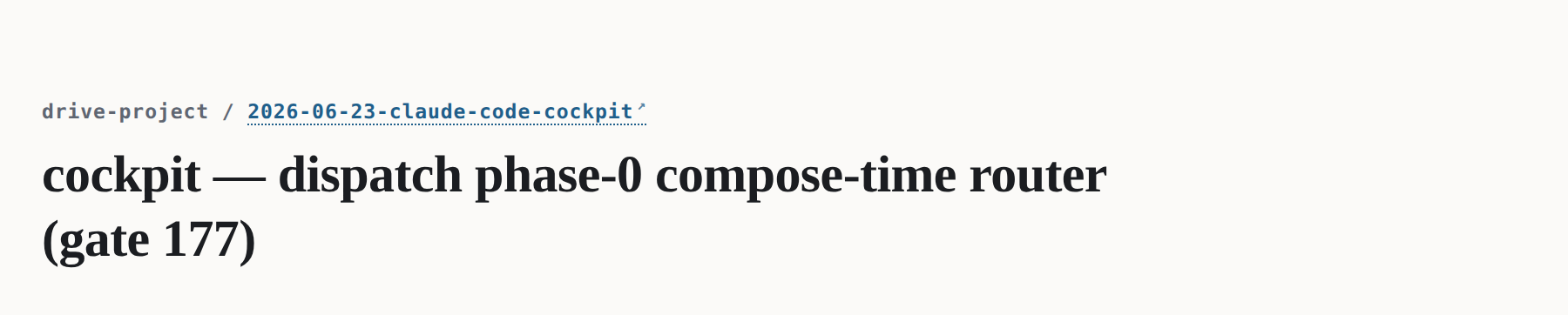
The column exists in the code, but a page shows it only when its spec asks for one. This gate's spec does not, so the project and the stage sit in the header as typed chips. Built by decision-surface-legibility.
The page header that day
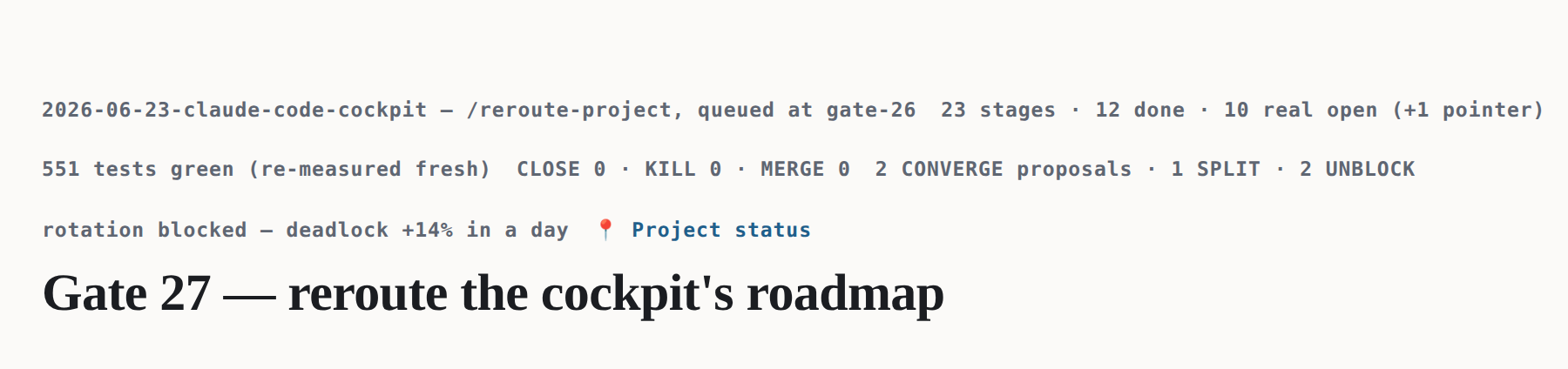
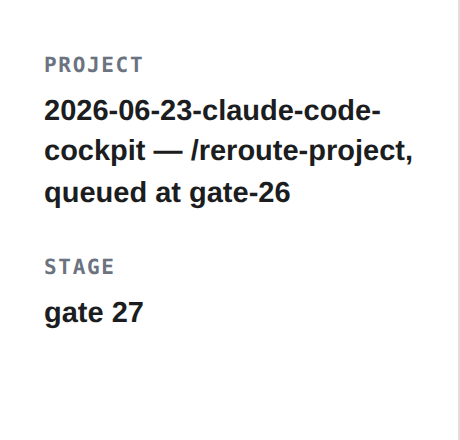
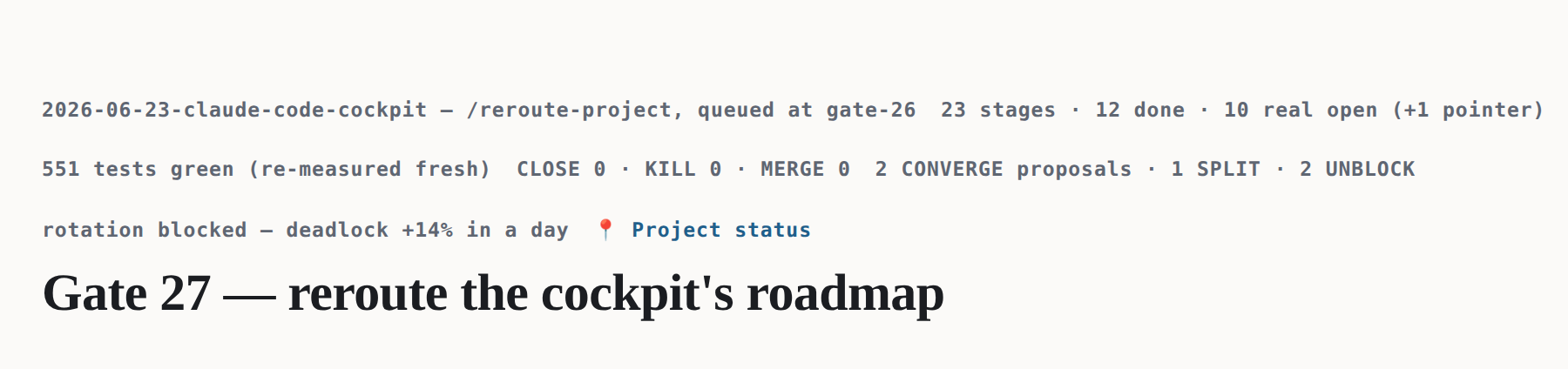
The same gate, rendered a day later. The column now derives the project and the stage from the gate itself, and stays out of the way when it has nothing to say. Built by decision-surface-legibility.
The page header that day
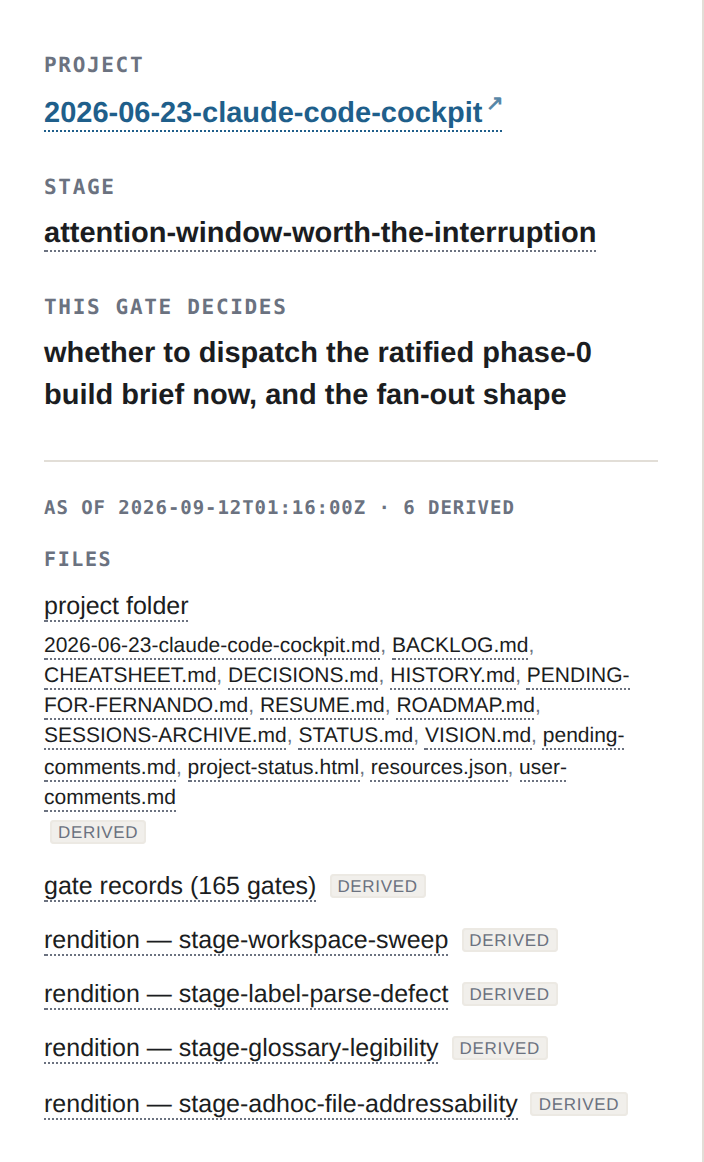
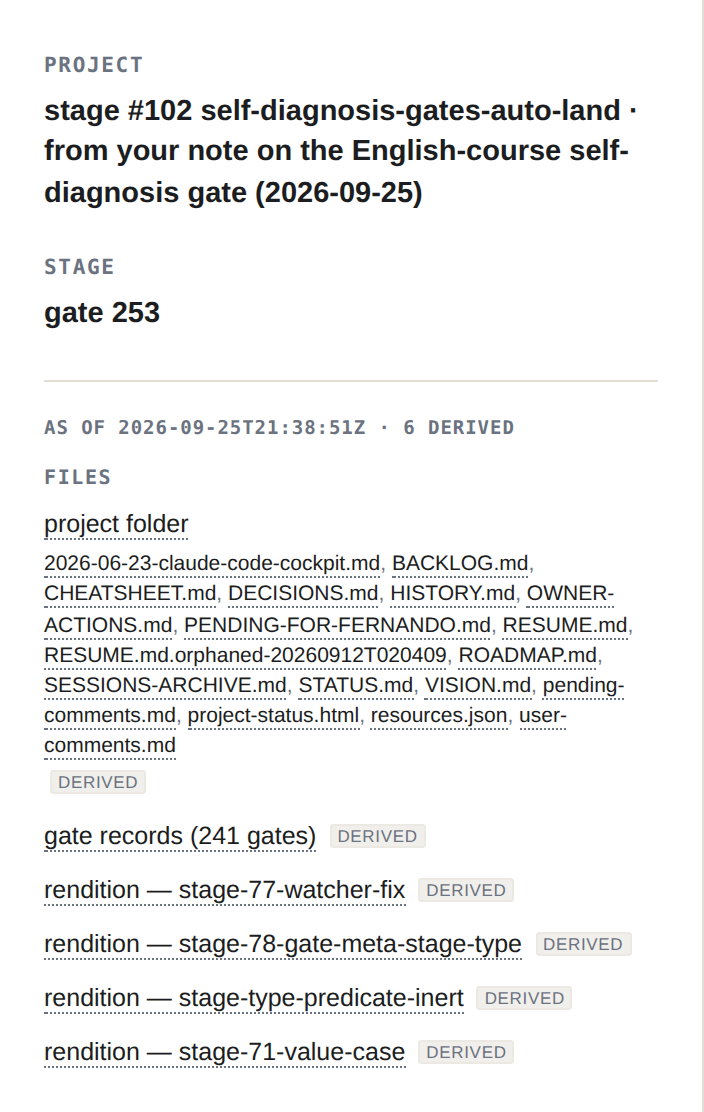
31 days on, the column lists the project's own files and gate records, derived for every project and tagged as derived. Built by a-resource-rail-for-decision-pages, after I had reported four times that only one project showed it.
The page header that day
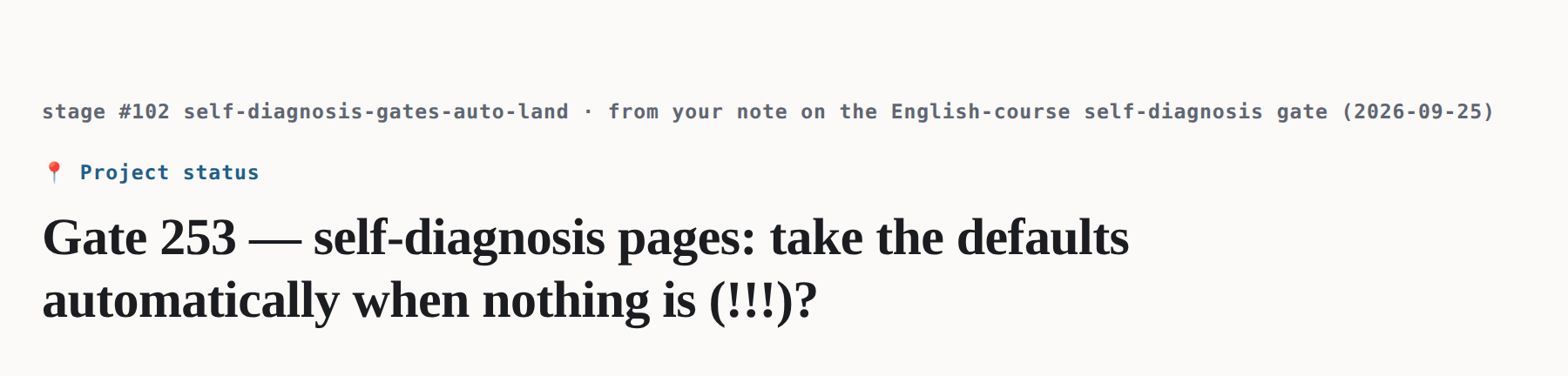
Nothing new in the column since the last state. The handoff box and the receipts reached the page itself the same day, from owner-trail, beside the column. This is the page where I dictated the convergence note quoted below.
The page header that day
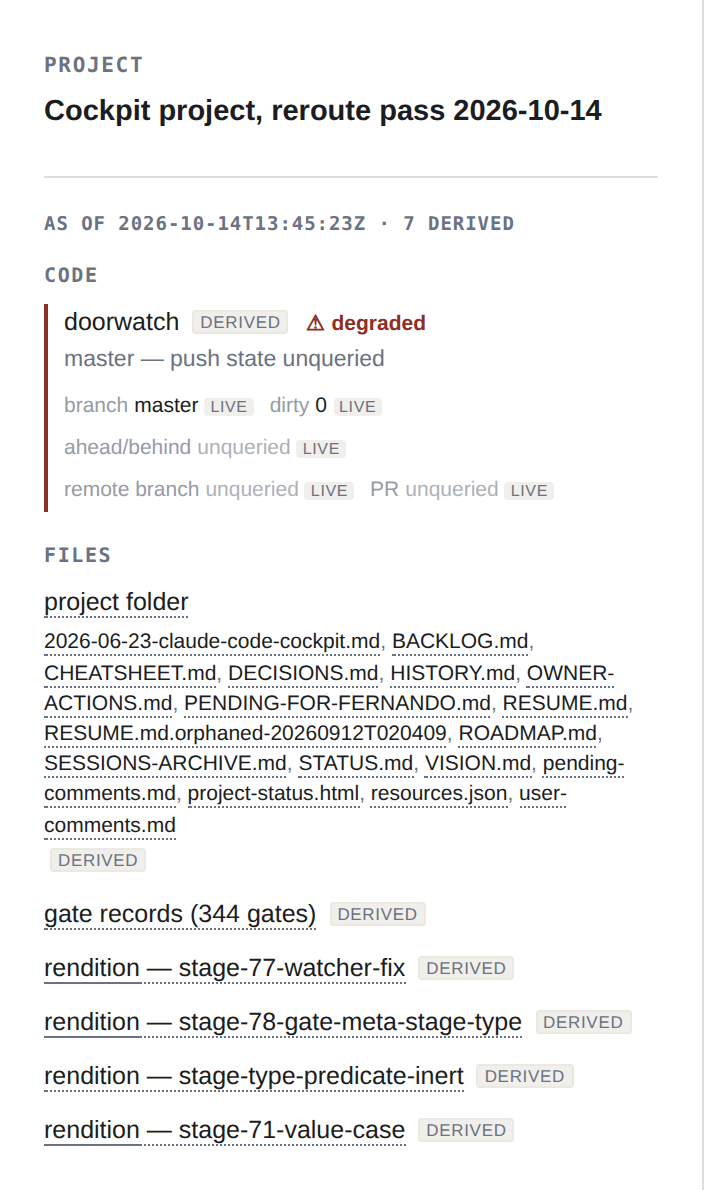
A code row appears, with live branch and working-tree probes. It comes from the same derivation as the file list: the project's own status document had named a repository since 6 October. That is my reading of the derivation; I did not render the page again without the mention.
The page header that day
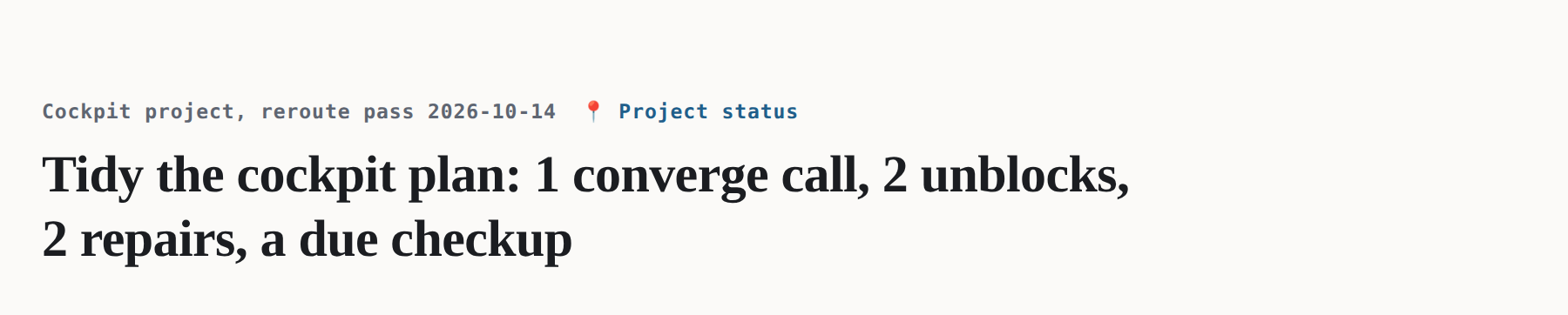
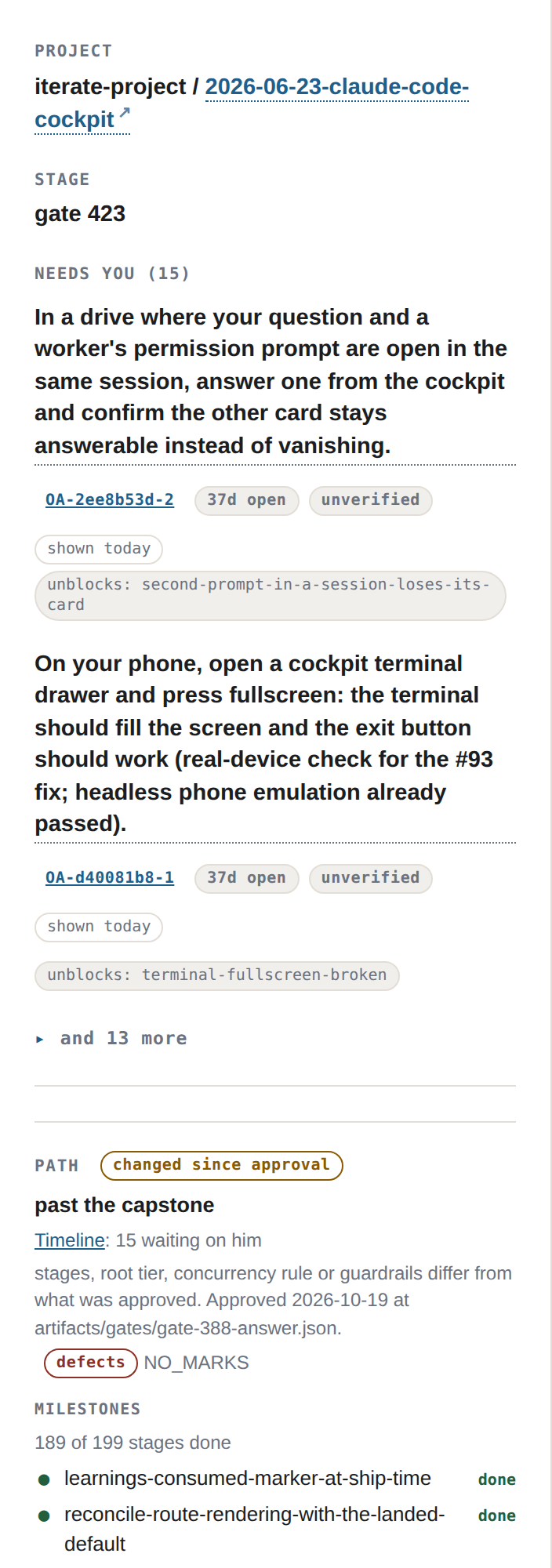
Two bands arrive. One is the approved path, from delegate-supervision-to-structure. The other is NEEDS YOU, what I owe, read from the ledger that owner-actions-ledger keeps. It lists 15 items. That is a lot, so this is a middle state.
The page header that day

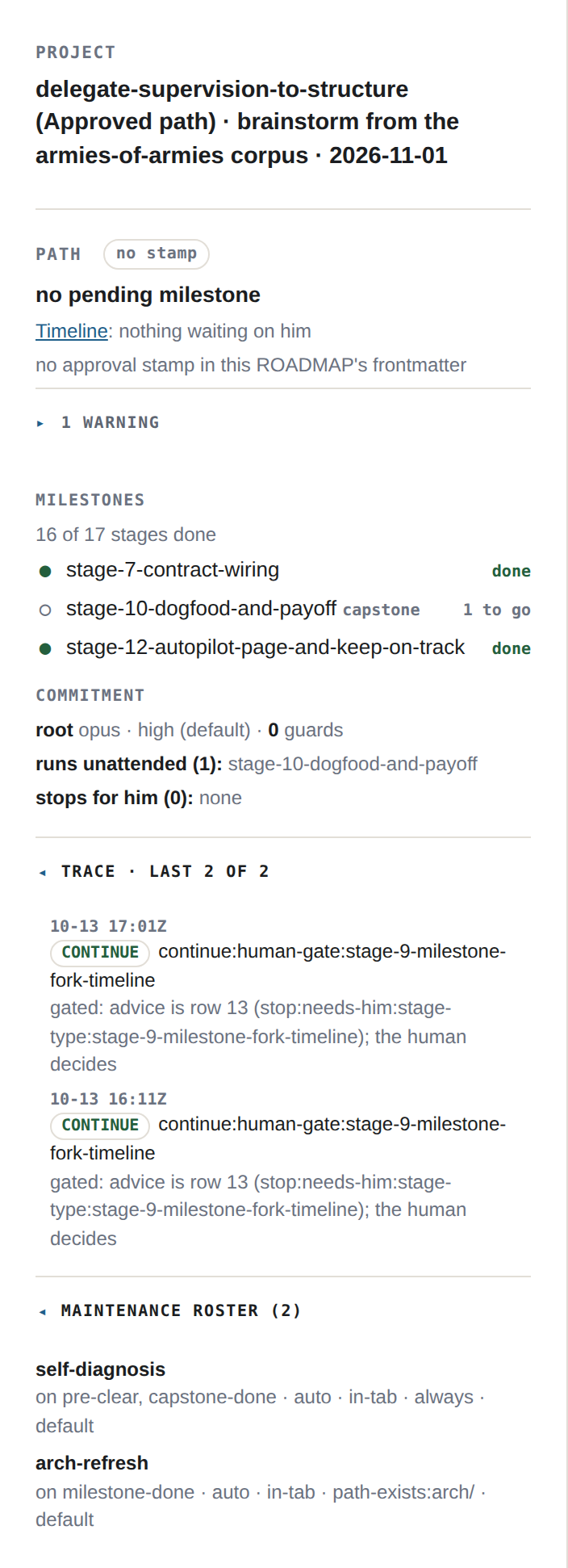
The same bands on another project, with nothing waiting on me: the approved path, 16 of 17 stages done with one capstone still to go, the trace of what the structure decided on its own, and the roster of maintenance that runs by itself. Same column, different project.
The page header that day
Exhibit 2Who left what in it
The column was never rewritten. From the second state on, every one opens with the same PROJECT row, and each state is the one before plus something a different project needed.
| Project | Started | What it left in the column | Where it landed in the tool |
|---|---|---|---|
| decision-surface-legibility | Aug 10 | the rail itself, and the rule that it derives the project and the stage on every page | commits fd10cb49 (Aug 10), 9408a9bc (Aug 11) |
| a-resource-rail-for-decision-pages | Aug 31 | the resource inventory, and the rule that every project gets one by default, not only the one that wrote a manifest | commits 6626db29 (Sep 2) |
| owner-actions-ledger | Sep 18 | the NEEDS YOU band, read from a ledger of what I owe | commits 89a9b551 (Oct 28) |
| owner-trail | Sep 25 | the handoff box and receipts on every decision page: on the page beside the column, not in it | commits 37070860 (Sep 25) |
| delegate-supervision-to-structure | Oct 10 | the approved-path block: milestones, commitments and the trace of what the structure decided on its own | commits 6c590ecb (Oct 13), 2e2d8517 (Oct 27) |
Exhibit 3The work around it
The numbers behind the chart
| Month | Touching the tool | Naming the column |
|---|---|---|
| June | 34 | 1 |
| July | 69 | 10 |
| August | 64 | 15 |
| September | 99 | 27 |
| October | 67 | 16 |
| November | 17 | 2 |
| Total | 350 | 71 |
The subject test, as a regular expression: \brail|session bar|path widget|handoff|glossary|timeline, case-insensitive. Commits are counted by author date.
Where it sits in my own rules
Before this card existed I had dictated a name for this kind of pattern. It is not a rule yet.
So convergence is designing for resilience to enable self-healing following some patterns that make it possible for agents to identify errors and like structure a process or methodology or algorithm that is able to identify things and react to them, adapting so that we keep true to our stage objectives and our project vision.
The two rules I already have that sit closest to it:
R19 self-healing seams — when a procedure leans on external state that drifts (a resource that rolls over / a ref that moves / a cache that expires), cache → validate-on-use → rediscover-when-stale → write-back → degrade gracefully (the drift sibling of R8); for genuine external drift ONLY, never a crutch for non-deterministic internal logic — determinism first, reach for it deliberately and flag it.
R41 self-improvement seams — the compounding twin of R19: where R19 keeps an external reference current against drift, R41 makes the system itself better over time by capturing and propagating the incidental, OUT-OF-scope learnings a sub-agent hits and resolves (a gotcha, tool/skill friction, a wrong assumption corrected, a better way) instead of letting them evaporate in task-scoped summaries that don't care about them — a self-improving procedure, not just a self-healing one.
Neither says that structure around a weak feature can pull it toward usefulness. The tenet is still converging itself: it exists as two parked drafts and no rule yet.
Something else I said, as dictated: “so many small things connect that they converge and new things emerge” (29 September). And, in short, what I said on 4 November when I asked for this card: that the column began as something barely usable, that I left it alone for over a month, and that it then converged on its own, without anyone redesigning it.
What this does not show. I have no run of the same column without the other projects, so I cannot say it would not have improved by itself. The commit counts measure activity, not usefulness, and the grey bars include work that has nothing to do with the column. Six of the seven states are pages of one project and the last is another project's, so some of what changes between them is the page and not the column. And the code row in the fifth state is my reading of how the derivation works; I did not test it.
The filmSeven states in one place
The seven states one after another in the same place, 1:19 on a wide screen. Turn a phone sideways and the picture changes to match.